Quick answer
Pause a washer that is moving, banging, or striking nearby surfaces. After the drum stops, redistribute a tangled or single-heavy-item load and remove items if the drum is packed. If the problem repeats, unplug the washer and check that the floor is firm, all feet contact the floor, and nothing touches the cabinet. For a newly installed or recently moved front-loader, compare the rear of the machine with the model’s installation guide to confirm all shipping bolts and packing were removed. Adjust feet only as that guide directs. Stop and request service for leaks, burning smells, metal-on-metal sounds, a visibly off-center tub, damaged feet or floor, or vibration that continues with a normal balanced load.
Safety before you start
Do not hold, climb on, or reach behind a moving washer. Pause or cancel the cycle and wait for the drum to stop before opening it. Unplug the washer before checking its feet or rear clearance, and shut off the water valves if a hose or connection is leaking and the valves are safely accessible. Never bypass the lid or door lock, remove cabinet panels, put hands under an unsupported appliance, or move a washer alone. Use the exact owner and installation manuals for your model before removing shipping hardware or adjusting feet.
What you need
- Washer owner and installation manuals
- Bubble level
- Flashlight
- Manufacturer-specified wrench for leveling feet, if required
- Phone camera for documenting feet, hoses, and rear hardware
- A second adult or appliance professional if the washer must be moved
Step-by-step
Pause the cycle and let the drum stop
Use the controls to pause or cancel the cycle. Keep clear of the cabinet while it slows, and do not try to restrain a washer that is walking. If you see water, smell burning, hear grinding, or see the cord being pulled, switch the washer off and disconnect power only from a dry, safely reachable location.
Correct an obvious load imbalance
After the door or lid unlocks, untangle the load and spread items evenly. A single absorbent item, rug, blanket, or small item mixed with bulky laundry can become lopsided. Follow the care label and washer manual; remove items rather than forcing a questionable load through another fast spin.
Check clearance around the cabinet
With the washer off, look for hoses, shelves, a dryer, or stored objects touching the cabinet. Contact can turn normal vibration into loud knocking. Do not kink, stretch, or disconnect hoses just to create space.
Test for rocking while the washer is off
On a dry floor, press gently at opposite top corners. A rocking cabinet suggests one or more feet are not firmly planted. Do not put fingers beneath the washer, tilt it, or shim it with improvised wood or cardboard.
Check level in both directions
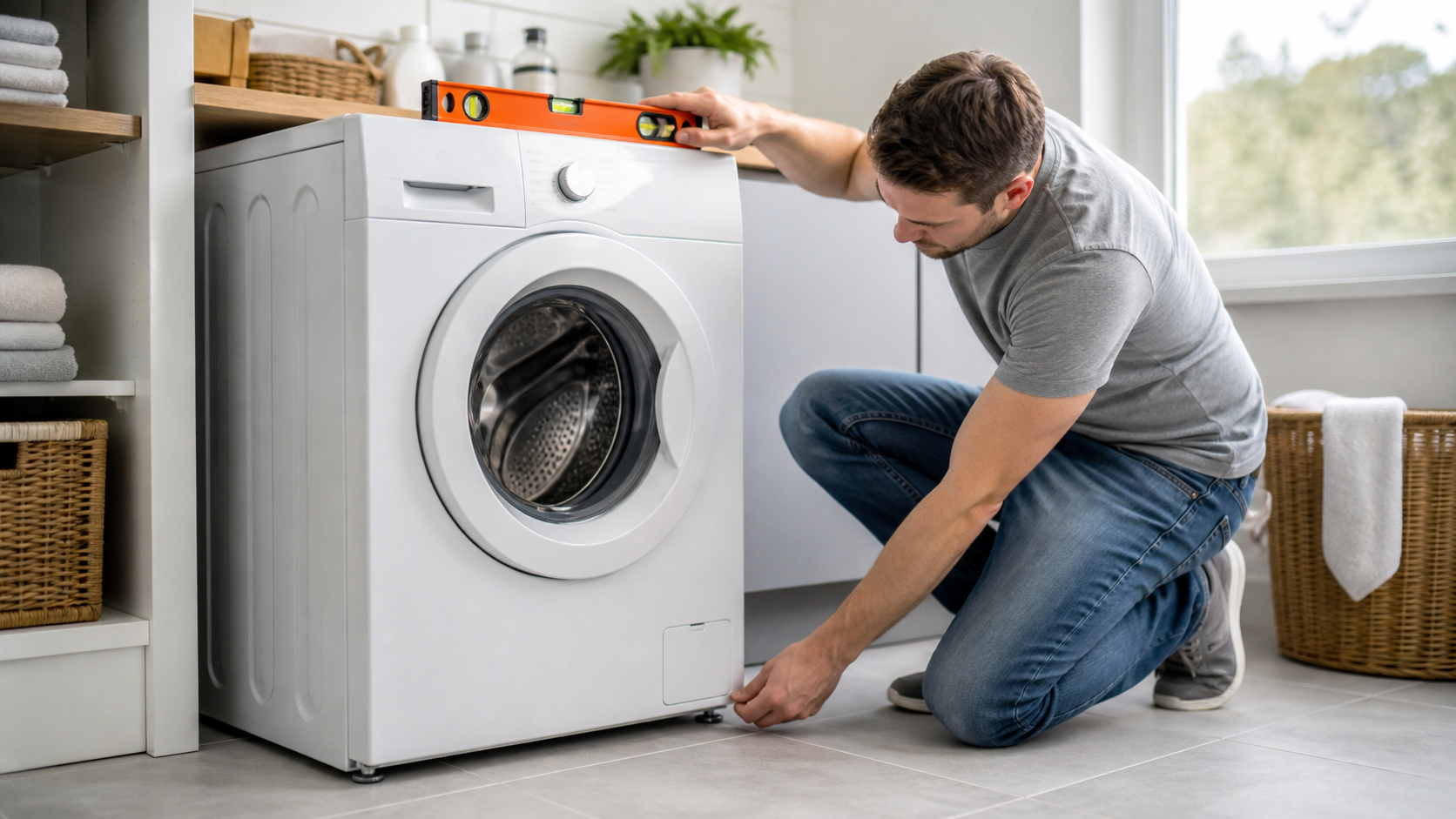
Place a bubble level across the top from side to side and front to back. Compare the result with the model’s installation instructions because leveling points, self-leveling rear feet, pedestals, and locknuts vary by design.
Adjust only the approved feet
Unplug the washer. If the installation guide permits owner adjustment, turn the specified leveling feet in small increments and tighten their locknuts exactly as directed. Keep every foot in solid contact with the floor. Stop if a foot is bent, seized, missing, or inaccessible without lifting the machine.
Check shipping hardware after a move or installation
Front-load washers commonly use shipping bolts or packing to secure the tub in transit. Use the model-specific installation guide to identify and remove only the hardware it names. Do not assume every rear bolt is shipping hardware, and do not remove anything from a washer that has not just been installed or moved without confirming the manual.
Run one manual-approved test and reassess
Restore power and run the manual’s recommended test or a normal balanced load while staying nearby. Stop if the machine walks, strikes the cabinet, leaks, or produces harsh mechanical noise. Persistent vibration after basic setup checks needs appliance service rather than repeated high-speed testing.
One bad load or an installation problem?
A washer that settles after laundry is redistributed likely reacted to that load. A machine that rocks while switched off, moves with ordinary loads, or has vibrated since installation points more strongly to floor contact, leveling, pedestal setup, or retained shipping material.
LG’s current vibration guidance lists unbalanced loads, an unleveled unit, and shipping bolts left in a front-loader as common checks. Whirlpool likewise directs owners to inspect load balance, level, feet, and the installation setup. These are screening steps, not proof that internal suspension parts are healthy.
Why the floor and feet matter
High-speed spin transfers force into the cabinet and floor. Four stable contact points on a firm, level surface help keep that force controlled; a loose locknut, unsupported foot, flexible floor, or incorrectly installed pedestal can let the cabinet amplify it.
Do not solve movement with loose shims, anti-slip objects not approved for the washer, or by wedging the appliance against a wall. If the floor flexes, is water-damaged, or is visibly out of level beyond the washer’s adjustment range, have the installation evaluated before using the machine again.
Stop-and-call-a-professional thresholds
- The washer leaks, smells hot or electrical, trips a breaker, or damages its cord or hoses.
- The tub appears off-center, sags, rubs, or makes grinding or metal-on-metal sounds.
- The cabinet still walks or strikes nearby surfaces after a normal load and correct leveling.
- A foot, pedestal, stacking kit, floor, or cabinet is bent, cracked, corroded, or loose.
- Moving or accessing the appliance would require lifting it, disconnecting hard-to-reach utilities, or working alone.
Common questions
Can an unbalanced load make a washer walk?
Yes. A single heavy or tangled item can collect on one side during spin. Pause the cycle, wait for the drum to stop, and redistribute or reduce the load. Repeated walking with ordinary loads still needs setup or service checks.
Should I remove bolts from the back of my front-load washer?
Only if the exact model’s installation guide identifies them as shipping bolts and the washer was newly installed or moved. Other rear fasteners are not interchangeable with shipping hardware.
Is it safe to keep using a washer that shakes violently?
No. Stop the cycle. Continued walking or hard impacts can strain hoses, the cord, flooring, and internal parts. Arrange service if a balanced load and manual-approved setup checks do not resolve it.
Prefer to hire a professional?
Find a local appliance repair company
Browse business profiles with published services, coverage, and direct contact information in the FixMate directory.
Sources and further reading
This article is original FixMate editorial content informed by the references below. Always follow manufacturer instructions and local code.