Quick answer
On a Dyson V8, rhythmic pulsing or repeated cutting out usually points to restricted airflow from a blockage, full bin, blocked inlet, dirty tool, or filter that needs washing. Confirm your exact V8 variant on Dyson's support selector first because filter shapes and service steps differ. Disconnect the charger, empty the bin, remove the cleaner head and wand, and inspect each accessible air path without pressing the trigger. Clear only visible debris with non-sharp tools. Wash the designated filters in cold water only, without detergent, and leave them to dry completely for at least 24 hours before refitting. If the bare main body still pulses after the accessible path is clear and fully dry filters are installed, or if there is battery swelling, heat, odor, damage, sparking, or a charger fault, stop and contact Dyson rather than opening the motor, cyclone, battery, or charger.
Safety before you start
Disconnect the vacuum from its charger before removing the bin, filters, wand, or cleaner head, and keep fingers away from the trigger during inspection. Do not run the machine while it is partially dismantled, probe hidden passages with metal or sharp objects, wash the cyclone or motor body, reinstall damp filters, or open the battery, charger, or motor housing. Never use a swollen, cracked, wet, unusually hot, smoking, hissing, or chemically odorous battery. Move away from a battery fire and call 911. Dyson service is the stop point for persistent pulsing with a clear air path, damaged components, abnormal heat or odor, intermittent electrical power, or a battery or charger diagnosis.
What you need
- Exact Dyson V8 serial number and matching support page
- Trash bin or bag for emptying dust
- Bright flashlight
- Soft dry brush and microfiber cloth
- Cold running water for washable filters only
- Dry, ventilated place for at least 24 hours of filter drying
Step-by-step
Match the exact V8 version
Use Dyson's V8 support selector or enter the serial number before following filter or cleaner-head instructions. V8 variants use different filter tops and accessories, so visual similarity is not enough for ordering parts or forcing a latch.
Disconnect charging power and empty the bin
Remove the vacuum from the charger and unplug the charger if you will work near it. Empty the bin before separating tools. Do not exceed the MAX fill line in regular use, because packed debris can obstruct the inlet.
Isolate the tool, head, and wand
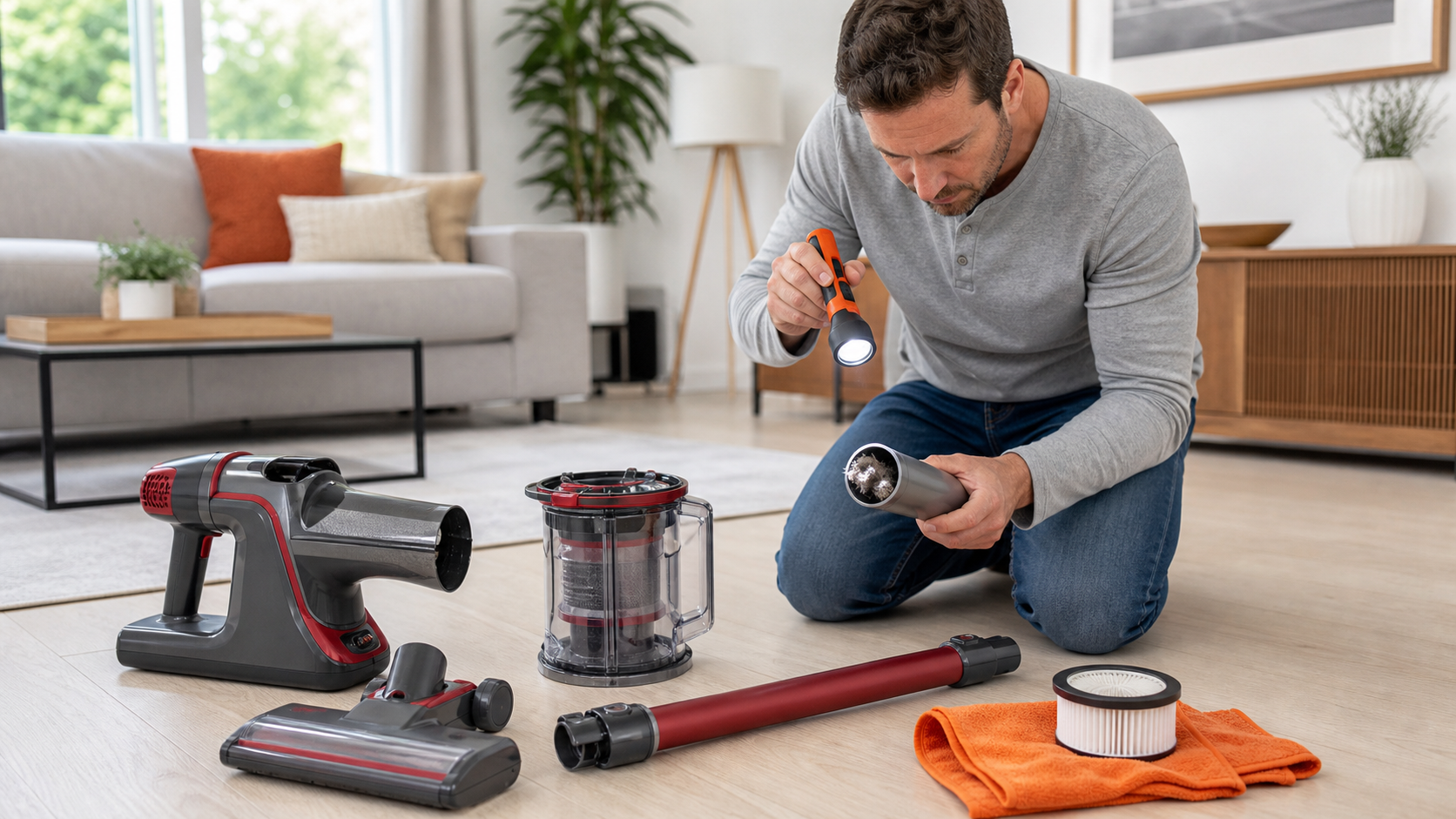
Without pressing the trigger, remove the floor head, wand, and other attachments. Shine a light through each hollow section and remove only visible hair or debris that comes free without sharp objects. Check both ends because a compressed plug can sit at a bend or coupling.
Inspect the bin inlet and accessible air path
Look at the bin inlet and the openings exposed by the normal emptying procedure. Remove accessible debris with a soft dry brush. Do not dismantle the cyclone or reach into the motor body; Dyson's guided troubleshooting should determine whether service is needed there.
Clean the correct filters
Remove only the filters shown for your V8 version. Rinse with cold water only until the water runs clear; do not use detergent or put filters in a dishwasher or washing machine. Keep the motor body, cyclone, battery, and charger dry.
Dry for at least 24 hours
Shake out excess water and leave the filters in a warm, ventilated place for a minimum of 24 hours and until completely touch-dry. Do not use an oven, microwave, tumble dryer, hair dryer, radiator, or open flame. A damp filter can damage the machine.
Reassemble and test one section at a time
Fit the dry filters securely, then use Dyson's model-specific troubleshooting sequence. If the main body operates normally until one attachment is fitted, that section remains restricted. If the bare unit still pulses with a clear inlet and dry filters, stop testing and contact Dyson support.
Pulsing is different from simply short runtime
Dyson describes the pulse as an audible protective response to restricted airflow. A vacuum that runs smoothly but for less time than expected may instead involve power mode, state of charge, temperature, battery age, or another electrical issue.
Do not buy a battery solely because the motor surges. Clear the air path and complete the filter checks first; then use Dyson's guided support for the exact machine if runtime or intermittent power remains the symptom.
Work from removable parts toward the main body
- Cleaner head: hair around the brush bar or debris at the neck.
- Wand: a compacted plug visible from either end.
- Small tools: lint or a lodged object at a bend.
- Bin inlet: debris preventing a clear path into the cyclone.
- Filters: fine dust restricting airflow even when the bin looks empty.
Stop before airflow work becomes electrical repair
The user-serviceable job is limited to the bin, removable tools, accessible blockages, and designated washable filters. A damaged electrical connector, battery pack, charger, trigger, motor, or sealed cyclone is not a DIY cleaning task.
Contact Dyson when model-guided checks do not clear the pulse, a part cannot be safely removed, a latch is damaged, or the machine shows heat, odor, swelling, smoke, sparks, or repeat electrical cutouts. Do not substitute unverified batteries or chargers.
Common questions
Why does a Dyson V8 pulse instead of just stopping?
Dyson says the pulsing sound indicates an airflow restriction and helps protect the motor. Common causes are a blockage, clogged inlet, dirty tool, or filter that needs cleaning.
Can I use the V8 while its filter is still damp?
No. Dyson requires the washable filter to be completely dry before refitting and specifies at least 24 hours of drying. Do not accelerate drying with heat or flame.
Does pulsing mean the battery is bad?
Not by itself. Pulsing is primarily an airflow clue in Dyson's guidance. A machine that runs smoothly but briefly is a different symptom; use the serial-number-specific support flow before replacing a battery.
Prefer to hire a professional?
Find a local appliance repair company
Browse business profiles with published services, coverage, and direct contact information in the FixMate directory.
Sources and further reading
This article is original FixMate editorial content informed by the references below. Always follow manufacturer instructions and local code.