Quick answer
A flashing error LED on a Husqvarna battery push mower can point to different conditions, and the flash count varies by model. Manufacturer guidance lists an incorrect start sequence, weak or poorly seated battery, motor overload from thick or wet grass or a low cutting height, high battery or motor temperature, and a blocked blade among the common branches. Stop on a dry, level surface, release the motor-brake handle, turn the safety key to 0, remove every battery, and wait at least five seconds before inspection. Record the light pattern and exact product number, let hot components cool, and clear only loose accessible debris while wearing heavy gloves. Stop for impact damage, heavy vibration, a blade that does not stop promptly, a swollen or leaking battery, damaged connectors, or an error that returns.
Safety before you start
The blade can start unexpectedly if energy remains connected. Before cleaning, adjustment, transport, or inspection, release the control, turn the safety key to 0, remove all batteries, and wait at least five seconds. Wear heavy gloves around the cutting area and never rely on the control handle alone. Do not reach under a raised mower, defeat the motor-brake handle or start inhibitor, operate with guards removed, hose off the battery or charger, open a battery pack, or test a damaged pack. Keep metal tools away from battery terminals and stop immediately for smoke, heat, swelling, leaking electrolyte, impact damage, or abnormal vibration.
What you need
- Exact mower product number and matching operator’s manual
- Phone camera for the LED pattern and product label
- Heavy-duty cut-resistant gloves
- Flashlight
- Dry soft brush or wooden scraper allowed by the model manual
- Charged manufacturer-approved battery known to match the exact mower
- Authorized Husqvarna service contact
Step-by-step
Stop and record the error before cycling power
Release the motor-brake handle and wait for the blade to stop. From the normal operating position, photograph or count the flashes and note whether the mower failed to start, slowed under load, or stopped. Do not assign a universal meaning to the count; Husqvarna says model-specific flash codes belong in the operator’s manual.
Isolate every energy source
Move to a dry, flat area. Turn the safety key to 0, remove the key, remove all installed batteries, and wait at least five seconds. Keep the key and packs away from the mower while working. Do not inspect a wet machine or handle a battery with wet gloves.
Check the start sequence and battery seating
Compare the sequence with the exact manual. Husqvarna notes that engaging the motor-brake handle too soon can prevent a start on some battery mowers. Inspect the dry battery bay for loose debris or obvious misalignment, then reseat a cool, undamaged, charged, approved pack only after the inspection is complete.
Separate heat and overload from a hard fault
If the mower stopped in thick, wet, or tall grass or at a very low cutting height, let the battery and motor cool completely with power removed. Raise the cutting height using the normal lever only while stopped, then resume on dry grass with a lighter cut. Do not repeatedly restart into the same heavy load.
Inspect the deck without reaching under an unsupported mower
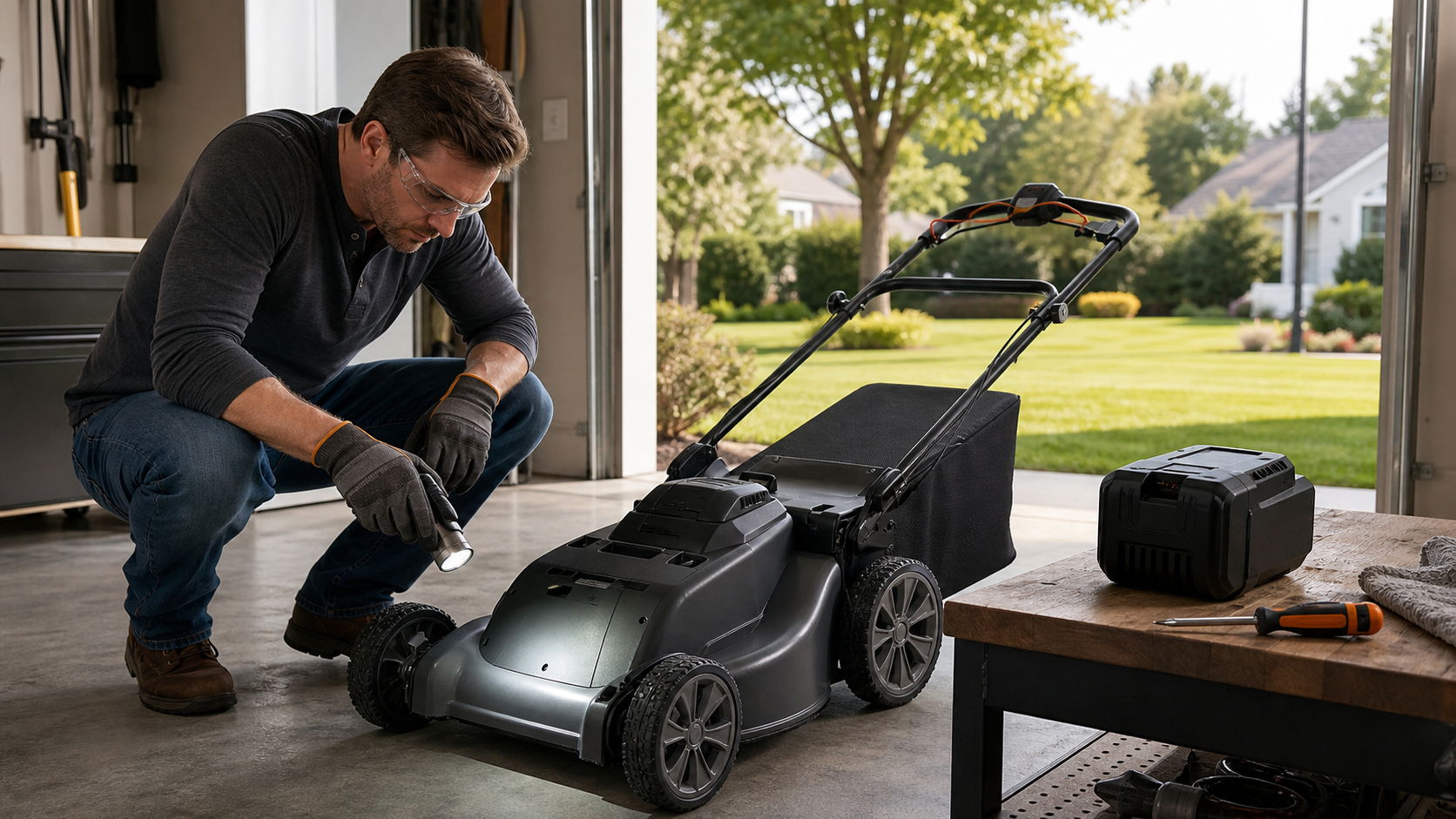
With the key and batteries removed for at least five seconds, use a flashlight to look for packed grass, a stick, wire, or impact damage. Follow only the model’s approved tilt and cleaning position. Wear gloves and remove loose accessible debris with a manual-approved nonmetal tool; never force or straighten a blade.
Reassemble, test once, and stop on recurrence
Confirm the battery bay, safety key, covers, catcher or discharge parts, and controls are correctly seated. Test from behind the handle on dry, level ground at a higher cut. If the LED returns, the motor-brake does not stop the blade as specified, or vibration, noise, smell, or heat appears, remove power and use an authorized service agent.
The moment the LED appears narrows the diagnosis
- Before the blade starts: verify the exact start sequence, safety key position, battery charge, and battery seating.
- In tall or wet grass: suspect load and cutting height before assuming a failed motor.
- After extended work in heat: remove the pack and allow both battery and mower to cool naturally in a dry shaded place.
- Immediately after a strike or with vibration: stop, remove power, and arrange inspection for blade, shaft, deck, or fastener damage.
- With a battery LED also flashing: use that battery’s model-specific status chart and do not substitute an incompatible pack.
Why the exact product number matters
Husqvarna’s general support page warns that the number of flashes varies by mower. An LE121P or LE221R manual, for example, lists specific counts for overload, hot motor control, blocked blade, weak battery, and connector faults. Those counts should not be copied to a different mower unless its own manual confirms them.
The product label also governs battery compatibility, charger instructions, tilt direction, deck access, and service parts. Matching by voltage or physical fit alone can create a safety and warranty problem.
Stop-and-call-an-authorized-service threshold
- The mower struck an object, now vibrates heavily, or the blade, deck, shaft, controls, or guards appear damaged.
- The motor-brake handle or start inhibitor does not work normally, or the blade does not stop promptly.
- The battery or connector is cracked, swollen, leaking, burned, wet, corroded, or unusually hot.
- The error returns after correct start sequence, cooling, charged battery seating, higher cut, and accessible debris removal.
- Inspection would require blade removal, electrical testing, opening the battery, or disassembling controls or the motor.
Common questions
What does the flashing LED on a Husqvarna battery mower mean?
It indicates a condition needing attention, but the flash count and meaning vary by model. Record the pattern and use the operator’s manual for the exact product number.
Can wet or tall grass make a battery mower stop?
Yes. Husqvarna lists thick or wet grass and a low cutting height as overload conditions. Remove power, let the mower cool if needed, raise the cut, and wait for dry conditions.
Can I turn the mower over to clear the blade?
Only use the tilt or service position in the exact model manual, after turning the safety key to 0, removing all batteries, and waiting at least five seconds. Never work under an unsupported mower.
Sources and further reading
This article is original FixMate editorial content informed by the references below. Always follow manufacturer instructions and local code.