Quick answer
A garbage disposal that hums without grinding is commonly mechanically jammed. Stop trying the switch. Turn the wall switch off, unplug the disposal or switch off its circuit breaker, and never put a hand into the grind chamber. Follow the exact model manual: compatible units can be worked back and forth from the bottom with the supplied disposal wrench or specified hex key, then visible debris can be removed with long-handled tongs. Let the motor cool, press the reset only as the manual directs, remove every tool, run cold water, and test briefly. Call a plumber or appliance technician if the shaft will not move, the reset trips again, or there is a leak; call an electrician for damaged wiring, a faulty switch, or a breaker problem.
Safety before you start
Turn off the wall switch and disconnect electrical power before inspecting or unjamming a disposal. A switch can be bumped and some disposals are hardwired, so use the breaker when needed. Never place fingers or hands inside the sink opening, even with power off; sharp glass and metal can remain hidden. Do not use caustic drain cleaner in a disposal. Stop for smoke, a burning smell, sparking, a hot cord, water near electrical parts, a leaking housing, or a breaker that trips again.
What you need
- Owner’s manual for the exact disposal model
- Bright flashlight
- Long-handled tongs or pliers
- Manufacturer-supplied disposal wrench
- Correct hex key only if the manual specifies one—often 1/4 inch on compatible models
- Cup or small bucket for standing sink water
- Dry towel kept away from electrical connections
Step-by-step
Stop after the first sustained hum
Switch the disposal off instead of pulsing it repeatedly. A motor that cannot turn can heat quickly and trip its overload protector. Keep everyone away from the sink opening and wait for the unit to become cool before continuing.
Disconnect power completely
Turn the wall switch off, then unplug the disposal under the sink. If it is hardwired, switch off the identified circuit breaker. If you cannot identify or control the power confidently, stop and call a qualified professional rather than reaching near the chamber.
Bail standing water and inspect from above
If the sink will not drain, remove enough water with a cup or bucket to see safely. Shine a flashlight through the splash guard. Use long-handled tongs to remove a visible utensil, bone, pit, or fragment. Never use a hand, and treat glass as a reason for extra caution or professional help.
Confirm the model’s unjamming method
Find the manual before applying force. InSinkErator and Whirlpool document a center socket on many models for a supplied wrench or specified hex key, but designs differ. Do not drill, pry, hammer, or force a tool into an opening that the manual does not identify as a wrench socket.
Work the bottom wrench back and forth
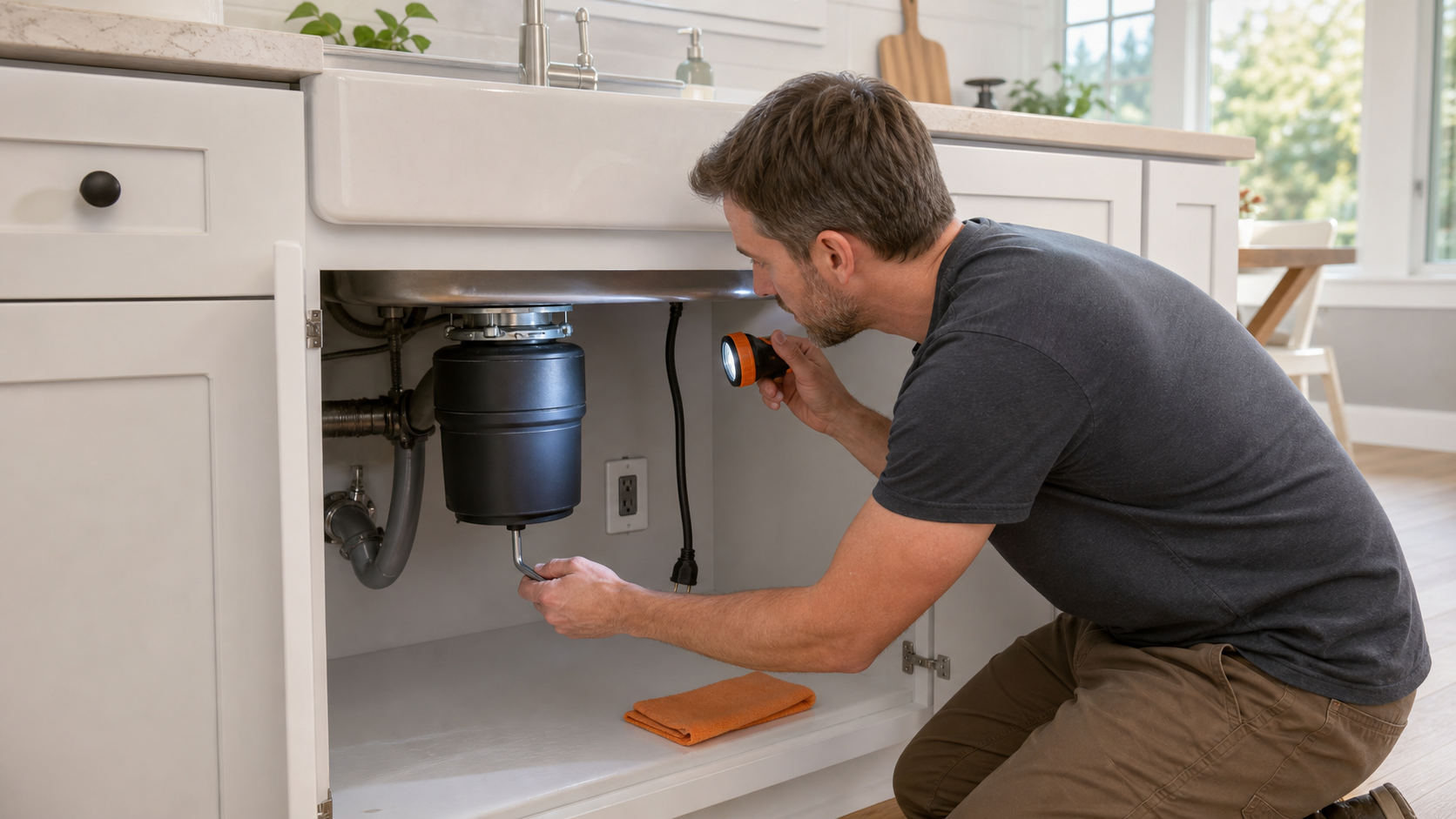
With power still disconnected, insert the correct wrench into the center bottom socket and move it gently in both directions. The goal is to free the turntable and complete a full revolution, not overpower a seized motor. Remove the wrench when movement is free.
Remove the object with tongs
Look into the chamber again and use long-handled tongs or pliers to lift out whatever the wrench freed. Check around the outer grind ring for another object. Do not reach in, touch sharp fragments, or leave the wrench or tongs in place.
Cool and reset according to the manual
Some models have a manual reset button; newer designs may reset automatically after a longer cooldown. InSinkErator documents up to 20 minutes for certain automatic-overload models, while other manuals specify shorter waits before pressing a red reset. Follow the exact model rather than guessing.
Test once with cold water
Confirm all tools are out and people are clear of the opening. Restore power, run a steady stream of cold water, and switch the disposal on briefly. If it hums, trips, rattles, leaks, or fails to reach normal sound immediately, switch it off and arrange service.
What the sound pattern suggests
- Steady hum with no grinding: power reaches the motor, but the rotating mechanism is likely obstructed or seized.
- Hum followed by silence: the internal overload may have opened after the motor heated.
- No sound at all: check the model’s reset procedure and the known power source, but treat repeated breaker trips or a failed switch as electrical service work.
- Metallic rattle or clicking: a foreign object may be moving in the chamber; disconnect power before using a flashlight and tongs.
- Motor runs but sink water does not drain: the drain line may be clogged, which is a different problem from a jammed motor.
Why the reset button is not the first fix
The reset is an overload protector, not a jam-removal control. If the grind mechanism is still blocked, resetting and applying power simply asks the stalled motor to heat again. Clear the mechanical obstruction with power disconnected before resetting.
A reset that will not stay engaged may mean the motor has not cooled or a fault remains. A reset that trips again after the shaft moves freely can point to a failing motor or electrical problem. Stop rather than repeating the cycle.
Shortcuts to avoid
- Never put a hand into the disposal, even when the wall switch is off.
- Do not keep pulsing a humming motor or hold the reset button in.
- Do not pour caustic drain cleaner, bleach mixtures, grease solvents, or boiling water into the unit.
- Do not use a broom handle, screwdriver, drill, or impact driver to force the mechanism.
- Do not remove wiring covers, test live voltage, or replace a hardwired switch unless qualified and permitted to do that work.
When the safe DIY path ends
Call a plumber or disposal service if the correct wrench cannot rotate the shaft, glass is embedded where tongs cannot reach, the housing or sink connection leaks, or the sink drain remains blocked after the motor runs. Replacement may be more appropriate for a seized or leaking housing.
Use a licensed electrician when the breaker trips with the disposal disconnected, the switch will not turn the unit off reliably, wiring or the receptacle is hot or damaged, or water has reached electrical parts. Smoke, sparks, or a burning odor require immediate power-off and urgent professional assessment.
Common questions
Can I put my hand in the disposal after turning it off?
No. Manufacturer instructions say not to put fingers or hands into a disposal. Disconnect power and use a flashlight with long-handled tongs or pliers for visible objects.
What size Allen wrench fits a garbage disposal?
Many InSinkErator and Whirlpool-style units use a supplied disposal wrench or a 1/4-inch hex key, but not every model has the same socket. Check the exact manual before inserting or forcing a tool.
Why does the reset button keep popping out?
The motor may still be hot, jammed, or electrically faulty. Disconnect power, confirm the shaft moves freely, allow the model-specified cooldown, and stop for service if the protector trips again during one brief test.
Prefer to hire a professional?
Find a local plumbing company
Browse business profiles with published services, coverage, and direct contact information in the FixMate directory.
Sources and further reading
This article is original FixMate editorial content informed by the references below. Always follow manufacturer instructions and local code.