Quick answer
First test the lamp or appliance in a known-working outlet. Then look for a tripped GFCI outlet in the same room or nearby rooms and press RESET. At the electrical panel, move the suspected breaker fully to OFF and then back to ON. Unplug high-draw devices before restoring power. Stop immediately for heat, sparks, smoke, buzzing, scorch marks, water exposure, or a breaker that trips again.
Safety before you start
This guide covers checks that do not require removing the outlet or touching wiring. Never insert a tool into an outlet slot. If you remove a cover or perform electrical work, power must be turned off and verified with a suitable tester; local permits and codes may apply. If you are unsure at any point, use a licensed electrician.
What you need
- A small lamp, charger, or plug-in device you know works
- A flashlight for the breaker panel
- Optional plug-in GFCI tester for routine testing
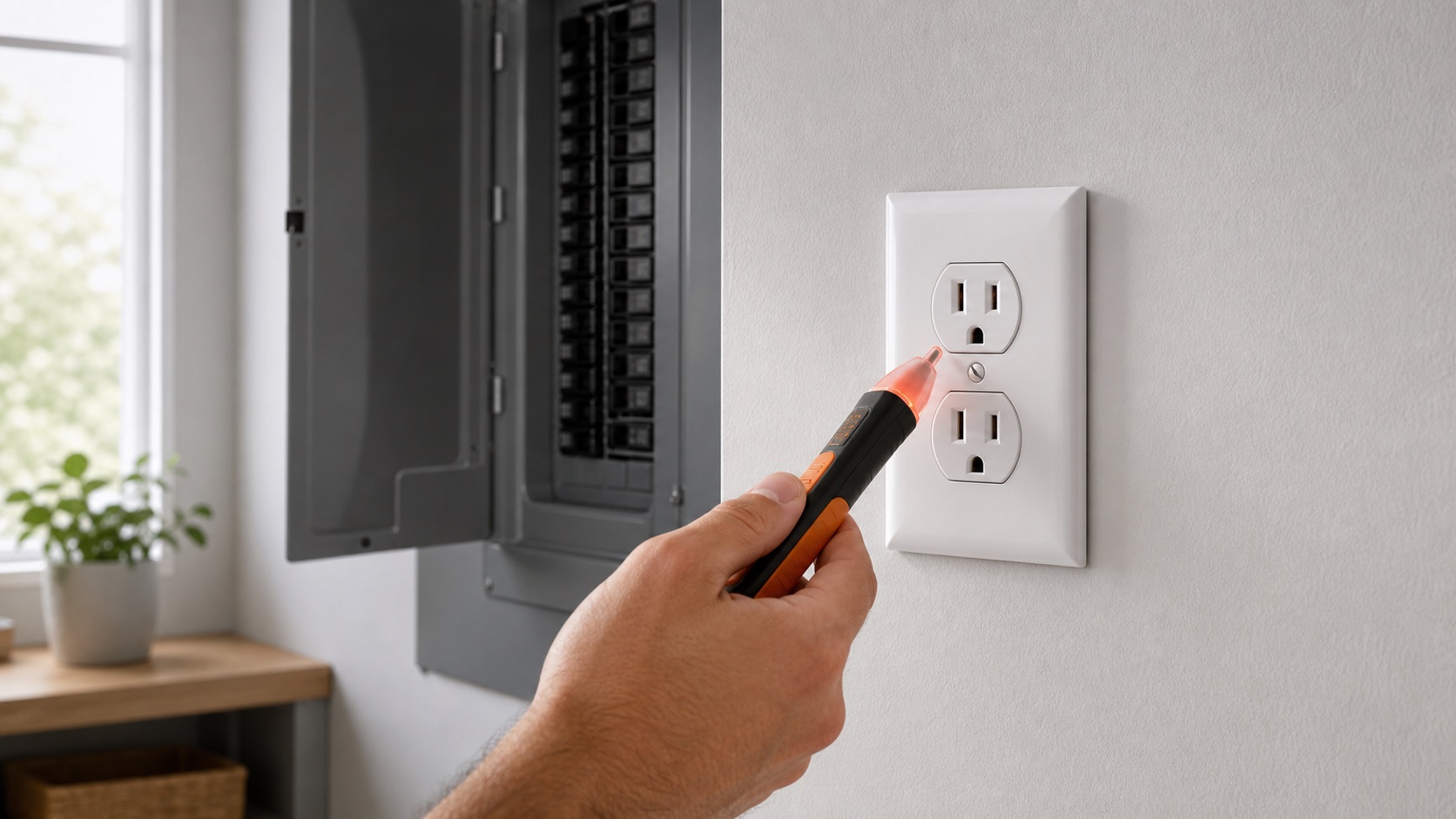
- No-contact voltage testers are useful screening tools but do not replace full verification before electrical work
Step-by-step
Stop if you see a danger sign
Do not touch or reuse an outlet that is warm or hot, sparking, smoking, buzzing, discolored, loose in the wall, wet, or giving off a burning smell. Turn off the circuit at the panel if you can do so safely and call an electrician.
Rule out the device
Unplug the lamp or appliance and test it in a known-working outlet. Then plug a small known-working device into the suspect outlet. This separates an outlet problem from a failed cord, charger, bulb, or appliance.
Look for a GFCI reset
In kitchens, bathrooms, garages, basements, laundry areas, and outdoors, one GFCI receptacle can protect several downstream outlets. Check nearby outlets for TEST and RESET buttons. Unplug devices, then press RESET firmly. Do not reset a wet GFCI.
Reset the breaker correctly
At the service panel, look for a breaker handle sitting between ON and OFF. Unplug high-draw devices on that circuit. Move the breaker fully to OFF, then back to ON once. If it trips again, leave it off and call an electrician.
Reduce the circuit load
A space heater, hair dryer, microwave, vacuum, or several devices running together can overload a circuit. Unplug unnecessary loads and redistribute them to different circuits. Do not use power strips as a way to increase a circuit’s capacity.
Check for a switched outlet
Some rooms have an outlet controlled by a wall switch. Test nearby switches, especially if only one half of a duplex outlet is dead. If the outlet remains dead after the safe checks above, it needs professional diagnosis.
What the pattern can tell you
- One device is dead everywhere: the device, cord, plug, or charger is likely the problem.
- One outlet is dead: the receptacle or a connection at that box or an upstream box may have failed.
- Several nearby outlets are dead: suspect an upstream GFCI, a tripped breaker, or a circuit fault.
- Only half of one outlet is dead: it may be controlled by a wall switch or have a failed internal connection.
- Breaker trips when one appliance starts: the appliance may be faulty or the circuit may be overloaded.
- Breaker trips with everything unplugged: leave it off and call an electrician.
Warm, sparking, buzzing, or loose outlets
Heat, arcing sounds, scorch marks, or a burning odor are not ordinary reset problems. Stop using the outlet and switch off its circuit if it is safe to do so. A loose-fitting receptacle that will not hold a plug securely is worn and should be replaced; do not bend plug blades to compensate.
Replacement involves identifying the circuit, verifying that power is off, matching the receptacle rating and protection type, and making code-compliant connections. Because mistakes can create shock and fire hazards, hire a licensed electrician unless you already have the training and test equipment for this work.
Why an outlet in another room may be the cause
A GFCI receptacle can protect outlets farther downstream on the same circuit. That is why a bathroom outlet may go dead when a GFCI in a garage, basement, or another bathroom trips. Walk the likely circuit and check every GFCI, including less obvious locations near utility sinks and exterior doors.
If a GFCI will not reset, make sure its breaker is on and unplug everything it protects. A GFCI that still will not reset may have failed or may be detecting a real ground fault. Do not bypass it.
When to call a licensed electrician
- The outlet is hot, sparking, buzzing, smoking, discolored, melted, wet, or smells burned.
- The breaker or GFCI trips again after one reset.
- The outlet is loose in the wall or cannot hold a plug.
- Multiple rooms lose power, lights dim or brighten unexpectedly, or you suspect a service problem.
- The panel uses fuses, shows damage, or has no clear circuit directory.
- You would need to remove the receptacle, alter wiring, add a circuit, or work without verified power-off testing.
Permits and electrical code
Rules vary by location. A one-for-one receptacle replacement may be treated differently from adding or extending a circuit, but all electrical work still has to meet applicable code. Check with your local building department before doing work, and use a licensed electrician when required.
Common questions
Why is my outlet dead but the breaker is not tripped?
An upstream GFCI may be tripped, the outlet may be controlled by a switch, or a connection or receptacle may have failed. Check known-working devices and all nearby GFCIs first; then call an electrician if the outlet stays dead.
Can I reset a breaker more than once?
Reset it once after unplugging loads. If it trips again, leave it off. Repeated resets can re-energize a fault and should not be used to keep a problem circuit running.
Is a warm electrical outlet normal?
No. Stop using a warm or hot outlet, unplug devices if safe, turn off the circuit, and have the outlet and circuit evaluated. Heat can indicate a loose connection, worn receptacle, overload, or damaged wiring.
Prefer to hire a professional?
Find a local electrical company
Browse business profiles with published services, coverage, and direct contact information in the FixMate directory.
Sources and further reading
This article is original FixMate editorial content informed by the references below. Always follow manufacturer instructions and local code.