Quick answer
Turn off a wobbling ceiling fan and let every blade stop before approaching it. From the floor, look for a visibly moving canopy or downrod, a drooping or cracked blade, contact with an object, or signs of a loose ceiling connection. If any appear—or the wobble is severe—leave the fan off and call a qualified electrician or fan installer. For a mild blade-only imbalance and a fan that is securely mounted, switch off the breaker, use a stable ladder only if you can work safely, clean the blades evenly, and tighten only accessible blade screws identified in the exact manual. Use only the manufacturer’s balance kit and procedure. Do not remove the canopy, touch wiring, bend blade irons, or adapt generic mounting hardware.
Safety before you start
A ceiling fan is both an electrical appliance and a suspended load. Keep people and breakable objects out from beneath it, switch it off, and turn off the correct breaker before touching any part. Use a fully opened, rated step ladder on a level dry floor; do not stand on furniture, the top cap, or an unsafe rung, and have another adult nearby. Do not remove the canopy, open the switch housing, probe wiring, tighten a ceiling box, bend metal blade holders, or work on a fan whose mount moves. Burning odor, buzzing, heat, loose wiring, ceiling cracks, water exposure, or movement at the ceiling requires a qualified electrician.
What you need
- Exact ceiling-fan owner and installation manual
- Stable rated step ladder appropriate for the ceiling height
- Second adult to steady the work area and pass tools
- Dry microfiber duster or cloth
- Manufacturer-specified screwdriver for accessible blade screws
- Tape measure for blade clearance and alignment observation
- Model-approved balancing kit with its instructions
- Phone camera used from the floor to document the symptom
Step-by-step
Switch the fan off and clear the area
Use the wall control or remote, wait for every blade to stop, and keep people away from below. If the fan is striking anything, dropping material, or moving at the ceiling, do not run it again for diagnosis.
Observe the mounting boundary from the floor
Look at the canopy, downrod, motor housing, blade holders, and ceiling surface. Movement where the fan meets the ceiling, a widening gap, cracked ceiling finish, a tilted downrod, or a loose-looking housing is not a blade-balancing task. Leave power off and call a qualified electrician or installer.
Confirm clearance without touching the fan
Hunter guidance calls for 30 inches between a blade tip and the nearest object. Check for curtains, plants, light cords, furniture, or a sloped ceiling that a blade could contact. Do not shorten, bend, or reposition fan hardware to create clearance.
Turn off the correct breaker
Before ladder work, isolate the circuit at the breaker and prevent another person from restoring it. If the breaker is unlabeled, shared unexpectedly, will not stay on, or you cannot verify the fan is de-energized without electrical testing, stop and use an electrician.
Clean every blade evenly
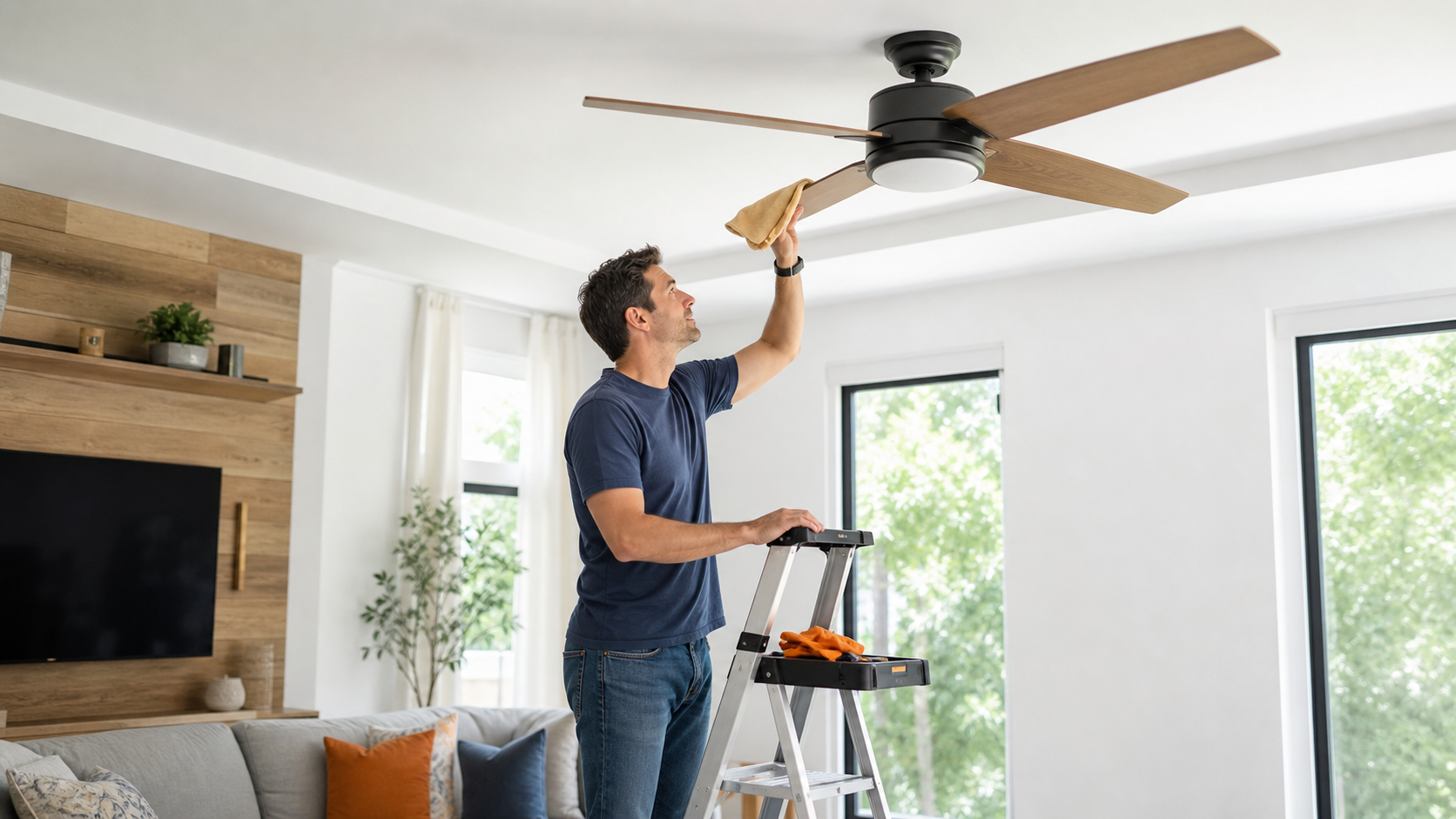
From a stable ladder, support each blade lightly while removing dust with a dry cloth. Uneven dust can contribute to imbalance. Do not lean sideways, pull down on a blade, soak the motor area, or rotate the fan forcefully.
Inspect blades and accessible screws
Compare blade height and look for cracks, swelling, warping, a loose blade, or a bent holder. Tighten only the blade screws the exact manual marks as owner-accessible, using the specified tool and normal hand pressure. Do not remove the canopy or straighten a bent metal holder.
Use the manufacturer’s balance kit only
If the mount is stable, blades are undamaged, and the manual provides a balance procedure, follow that kit’s clip-and-weight sequence exactly. Keep temporary clips secure and remove them as instructed. Do not tape coins, improvised weights, or loose objects to a blade.
Run one cautious check from clear ground
Restore power only after all tools and people are clear. Start at the lowest speed and observe from outside the blade sweep. Switch off immediately if wobble persists, worsens, produces noise, or involves the canopy or downrod. Do not keep testing at higher speeds to prove the repair.
Blade imbalance or mounting problem?
Dust, uneven blade weight, loose blade screws, or a warped blade can make the rotating plane look uneven. Hunter directs owners to check clearance, hardware, and its supplied balance kit, while emphasizing the model-specific manual.
The safety line is the ceiling connection. ENERGY STAR says a fan requires an appropriate fan-rated outlet box and secure structural support. A homeowner cannot confirm that hidden support by watching the blades, so canopy, bracket, box, wiring, or ceiling movement belongs with a qualified electrician or installer.
Do not mix blades, brackets, or balance methods
Blade sets are matched by model, dimensions, weight, hole pattern, and finish. Replace a cracked or warped blade only with a manufacturer-confirmed part or matched set; a similar-looking blade can create a new imbalance.
The same caution applies to mounting brackets, downrods, screws, and control parts. Do not reuse or adapt generic hardware, and do not assume a light-fixture box is fan-rated. Hidden structural and wiring corrections require the proper listing, support, local-code knowledge, and electrical testing.
Leave the fan off and call a professional when
- The canopy, downrod, ceiling plate, electrical box, or ceiling surface moves, gaps, cracks, or sags.
- A blade, blade holder, light kit, globe, pull chain, or fastener is cracked, bent, loose, or missing.
- The fan buzzes, smells hot or burned, sparks, trips a breaker, slows unexpectedly, or has been exposed to water.
- The fan was recently installed or moved and the support box, bracket, downrod, or hardware cannot be verified from the manual.
- The work requires canopy removal, wiring access, an unsafe ladder reach, structural support, or repeated running tests.
Common questions
Is a wobbling ceiling fan dangerous?
It can be. Mild blade imbalance and unsafe movement at the ceiling can look similar from a distance. Switch the fan off and use a professional whenever the canopy, downrod, mounting point, or ceiling moves.
Can I balance a ceiling fan with coins or tape?
No. Loose improvised weights can detach and do not follow the fan’s tested procedure. Use only the model-approved balancing kit after confirming the fan is securely mounted and the blades are undamaged.
Should I remove the canopy to tighten a wobbling fan?
Not as a basic DIY check. The canopy covers the mounting and electrical area. Movement there, an unknown fan-rated box, or loose wiring should be evaluated by a qualified electrician or installer.
Prefer to hire a professional?
Find a local electrical company
Browse business profiles with published services, coverage, and direct contact information in the FixMate directory.
Sources and further reading
This article is original FixMate editorial content informed by the references below. Always follow manufacturer instructions and local code.