Quick answer
First separate a true no-spin condition from a load that spins poorly. Samsung’s current troubleshooting says to check load size, balance, and cycle selection for poor spin. If the tub does not spin at all, remember that the washer tries to drain before it spins. On a front-loader with a user-accessible pump filter, follow the exact model manual to drain residual water and clean that filter. Inspect the external drain hose for kinks and correct installation, then use only the calibration procedure documented for your model. Request service if the tub does not turn during calibration, the machine will not drain, an error persists, or you find leaking water, a damaged cord or hose, burning odor, smoke, or abnormal grinding.
Safety before you start
Unplug the washer and close its water supplies before opening any user-serviceable filter door or moving the appliance. Residual water may be hot; let it cool and drain it into a low pan slowly. Never reach into a moving drum, defeat the door lock, remove the rear or cabinet panels, touch wiring, or tip the machine. A washer is heavy and can damage flooring or hoses when moved. Stop for smoke, burning odor, electrical heat, a repeated breaker trip, active leaking near power, a cracked drum, or a grinding tub, and use an appliance professional.
What you need
- Exact washer model number and matching Samsung user manual
- Shallow drain pan or low-sided container
- Absorbent towels
- Soft-bristle brush
- Flashlight
- Tape measure for the visible drain-hose installation
- Phone camera for the load, hose, and display
Step-by-step
Record whether the washer drained
Pause the cycle and note standing water, an error display, unusual sound, and whether the drum ever attempted to turn. Do not force a locked door. If water remains, treat the symptom as a drain problem first because Samsung explains that the washer drains before it advances to spin.
Correct the load and cycle
If the tub turns but clothes finish unusually wet, redistribute tangled sheets or a small off-center load and choose a cycle and spin speed allowed by the care labels and model manual. Do not add dry items to a drum full of standing water. A no-spin or low-spin cycle can leave more water without indicating a failed motor.
Identify the model before opening a filter door
Use the model label and Samsung’s manual lookup. Samsung’s general guidance states that only front-load models have the pump filter described in its no-spin flow. If your manual does not identify a homeowner-accessible pump filter, do not remove a panel or copy a procedure from a different washer.
Drain and clean an accessible front-load filter
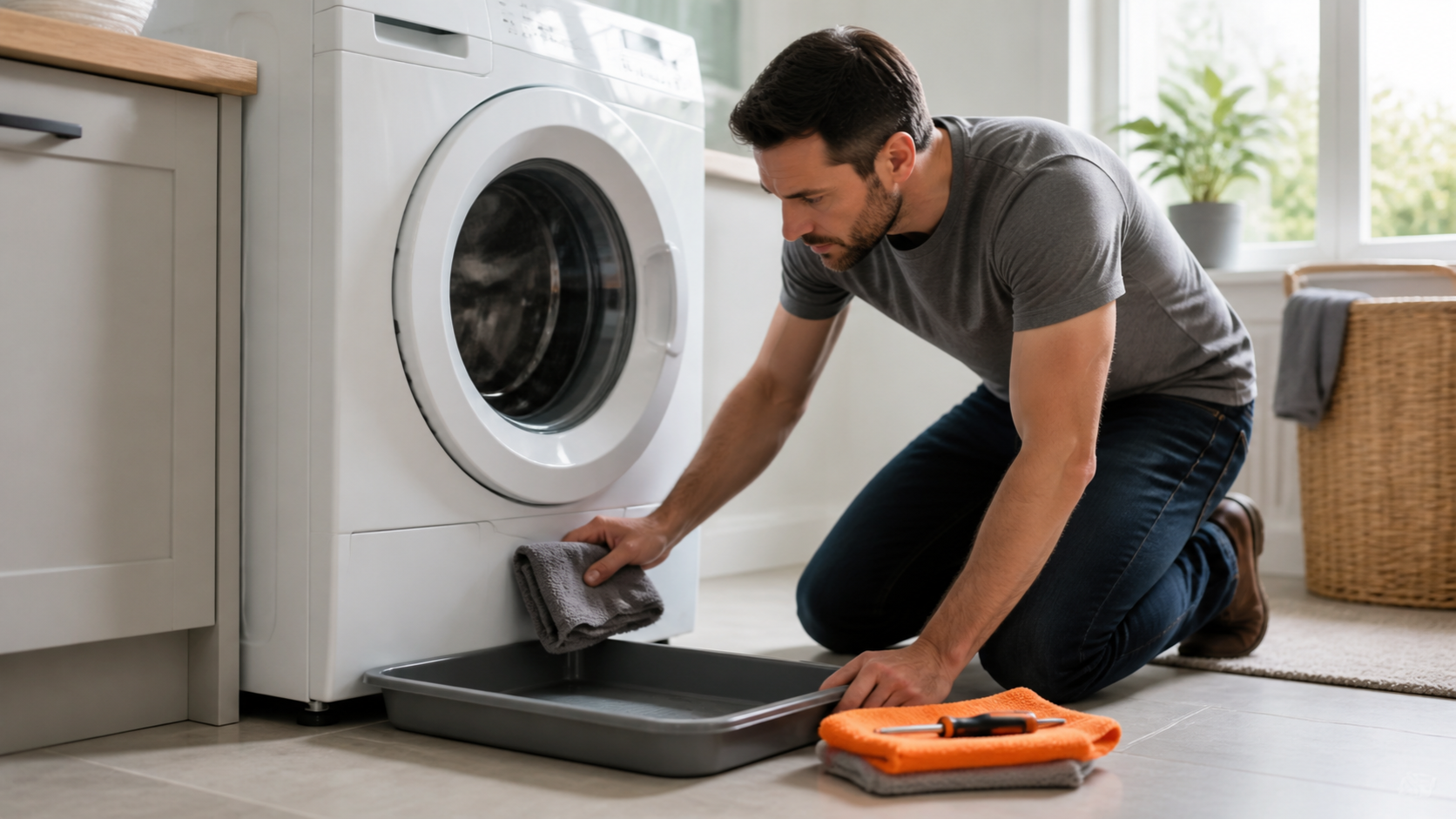
With the washer unplugged, water valves closed, and water cool, place towels and a low pan at the access door. Follow the exact manual to empty the small emergency drain hose before removing the pump filter. Clean the removable filter with a soft brush, clear loose debris you can reach without tools, reinstall it fully, and cap and clip the drain hose before closing the door.
Inspect the external drain hose
Check the visible hose for crushing, sharp bends, damage, or an airtight standpipe seal. Samsung’s U.S. troubleshooting specifies 6 to 8 inches of insertion, a normal standpipe height of 18 to 96 inches, and no drain-hose extension; sink installations have different height limits. Confirm those dimensions against your model manual and installation type. Do not remove the hose-holder screw from the washer.
Run only the model-documented calibration
Empty the drum completely and look up Calibration Mode in the exact manual. Button combinations vary, and Samsung says some models do not have this mode. Do not guess at service-menu commands. Keep clear while the tub moves and stop if the washer walks, leaks, grinds, or strikes the cabinet.
Use the result to set the service threshold
If the tub does not turn during the documented calibration, Samsung directs owners to request service. Also stop if the washer cannot drain after the accessible checks, the filter will not reseal, the drain hose is damaged, the breaker trips, or a mechanical or electrical symptom remains. Internal pump, motor, belt, control, bearing, or lock diagnosis is outside this guide.
No spin and poor spin lead to different first checks
A load that completes with damp clothes may have spun at a reduced speed because of its cycle, size, fabric mix, or imbalance. A washer that holds water and never reaches spin points first toward drainage. Observing the sequence is more useful than guessing a failed component from wet laundry alone.
Run a test only after leaks are contained and the filter and hose are restored. Use a small, ordinary load rather than one bulky item, and remain nearby. A successful empty calibration does not prove every loaded-cycle problem is fixed, but a tub that never turns gives Samsung’s published service boundary.
The accessible filter is not permission to open the washer
- Open only the filter access point identified in the exact model manual.
- Drain residual water before loosening the filter to prevent a floor flood.
- Do not reach into the filter housing with the washer connected to power.
- Do not remove the rear drain-hose holder or add an unapproved extension.
- Replace a damaged hose or nonsealing filter through qualified service.
Stop before a simple symptom becomes a larger repair
Grinding, a loose-feeling inner basket, visible sparks, hot electrical odor, recurring leaks, or a breaker that trips are not load-balancing problems. Disconnect power when it is safe to do so, close the water valves, and arrange service without another test cycle.
Give the technician the exact model, displayed code, whether water drained, what happened in the documented calibration, and photos of the external hose route. That evidence is more useful than naming a suspected internal part.
Common questions
Why will a Samsung washer not spin when water is still inside?
Samsung explains that the washer attempts to drain before it advances to spin. A blocked accessible front-load filter, restricted external hose, or another drain fault can therefore appear as a no-spin symptom.
Do all Samsung washers have a pump filter I can clean?
No. Samsung’s general troubleshooting identifies the described user-accessible pump filter as a front-load feature. Use the exact model manual and do not remove cabinet panels to look for one.
Should I run Samsung washer calibration if the tub does not spin?
Only run Calibration Mode exactly as the manual for your model describes, with an empty drum and no active safety symptom. Samsung directs owners to request service if the tub does not turn during that test.
Prefer to hire a professional?
Find a local appliance repair company
Browse business profiles with published services, coverage, and direct contact information in the FixMate directory.
Sources and further reading
This article is original FixMate editorial content informed by the references below. Always follow manufacturer instructions and local code.